River Tech is a defined, integrated K–12 school model — three pillars at equal weight, dual-track enrollment, competency-based progression, and a Christian framework in the mere-Christianity tradition. This page walks through every part of it.
The Three Pillars.
Every River Tech school holds three pillars at equal weight. No pillar is treated as enrichment, and no pillar carries the others. An emerging fourth pillar — Athletics and Physical Fitness — is in active development at the flagship school.
Performing Arts
Not electives. Not enrichment. A core discipline every student studies from kindergarten on.
- Music. Every student learns drums, bass, ukulele, guitar, keyboard, band, and vocals.
- Theater. Acting, dance, and musical theater. Annual public productions involving every student.
- Choir. Ensemble singing as a weekly practice.
- Production. Students work on stage and behind it — sound, lighting, set, costumes.
Theological rationale. Creativity is part of bearing the image of God. Art is not decoration — it is a human vocation.
Technology
A making discipline, not a consuming one. Students build tools, not just use them.
- Programming. Scratch Jr → Scratch → Python → C# with Unity.
- Robotics. Gizmo → Vex → Arduino, with progressive hardware and design challenges.
- Design. 3D modeling in Blender, filmmaking, digital arts.
- AI literacy. Critical use of current AI tools — what they're good at, what they aren't, what's theirs and what's yours.
Theological rationale. Technology is stewardship — dominion in the original sense. We build well because the world was made well.
Core Academics
Rigorous, sequential, and taught in small groups — not a light touch around the edges of the arts.
- Subjects. Math, English, Science, History, Literature, Bible.
- Ratio. 1:15 teacher to student.
- Progression. Competency-based — students advance when they've mastered the material.
- Differentiation. A student can be at different levels in different subjects simultaneously.
Theological rationale. Truth is knowable and worth the effort. The mind is worth training.
Athletics & Physical Fitness
A fourth pillar in active development. The body is not an afterthought, and physical stewardship belongs alongside the other three.
Scriptural rationale. "Do you not know that your bodies are temples of the Holy Spirit?" (1 Corinthians 6:19–20)
Curriculum, not just content.
River Tech publishes a curriculum architecture, not a textbook list. The architecture defines what students should be doing, at what competency, and in what sequence. The specific materials are chosen by the operator in consultation with us.
Progression is competency-based. A fifth grader strong in math and still finding their feet in writing moves forward in math and is supported in writing — not held back or pushed forward by the calendar. The goal is real mastery, not grade-level theater.
The curriculum runs on a 7-period day for full-time students (8:30 AM – 2:35 PM), with pillars interwoven across the week rather than siloed into one block.

A community model, not just a school.
A River Tech school is embedded in a local church community — not as a ministry of the church, and not as a tenant of it, but as a partner with it. The church typically provides facility access and neighborly stability. The school operates independently. The community gets a school its children can walk to.
Church as host, not owner
The school operates as its own entity with its own governance. The church provides space and neighborly support, not curriculum control.
Families as participants
Parent-teacher meetings, shared meals, volunteer roles on productions. Families are involved in the school week, not just the parking lot.
Public productions
At least one full public musical production every semester. Neighbors, pastors, alumni, and grandparents all in one room. The production is the community's.
Dual-track enrollment.
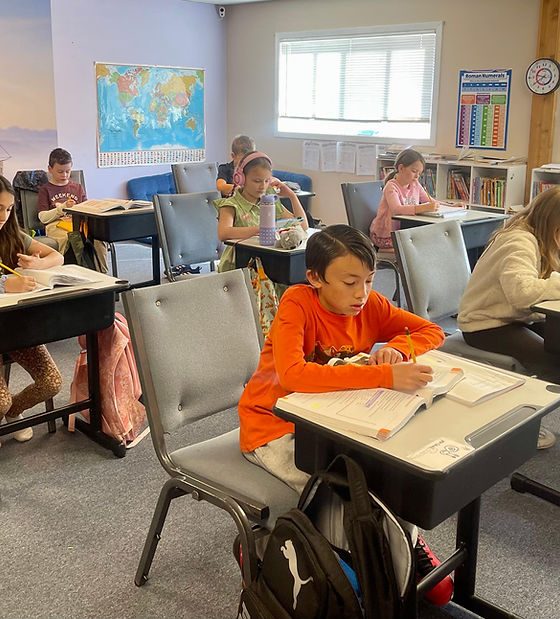
River Tech schools serve two student populations in the same building, at the same time, with the same teachers. Full-time students sit alongside homeschool-enrichment students who come one to four days a week — and both get a complete program.
Full-time track
4 – 5 days per week, 8:30 AM – 2:35 PM. A complete K–12 program across all three pillars. Most full-time families are committing to River Tech as the child's primary school.
À la carte track (homeschool enrichment)
1 – 4 days per week, with each day themed so that a family attending even one day a week gets a complete program area. The week is structured so no pillar is "the day a family missed."
- Monday — Performing Arts intensive
- Tuesday — Science intensive
- Thursday — Life Skills
- Friday — Technology intensive
The two tracks are not separate programs that happen to share a building. The integration is the feature — à la carte students benefit from the ensemble energy of full-time students, and full-time students benefit from the fresh perspective that homeschool families bring.
A Christian framework that means it.
River Tech is explicitly, broadly Christian — in the mere-Christianity tradition of C.S. Lewis. Not a denominational school, not a post-Christian school with Christian vocabulary, and not a "values-based" school that quietly dropped the subject.
The framework shows up in four concrete practices:
- Daily assembly. The whole school gathers every morning.
- Bible class. Structured, academic, and on the schedule — not a devotional afterthought.
- Chapel. A weekly worship service, age-appropriate and unapologetic.
- Theological rationale for each pillar. Arts as image-bearing, technology as stewardship, academics as pursuit of truth.
This is non-negotiable. A school that removes this framework is no longer a River Tech school. Licensees agree to this in writing — not because we are enforcing conformity, but because the concept does not survive without it.
Want to see the model in operation?
The flagship school in Post Falls has been running this concept live since 2021. Read how it's going — six productions, seventy-five students, and a community that answered when the building burned.